
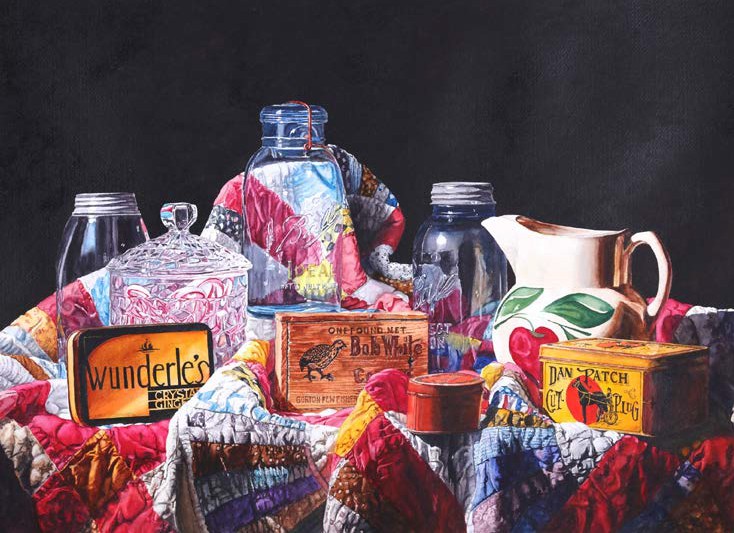
There are artists who are good at what they do. There are artists who are great at what they do. And then, occasionally, there is someone like Laurin McCracken — a watercolorist whose technical mastery, intellectual curiosity, and sheer force of personality have made him one of the most influential figures in contemporary watercolor. Last week, the Watercolor USA Honor Society made it official, presenting McCracken with its Lifetime Achievement Award at the Watercolor USA annual meeting on May 29.
To mark the occasion, fellow watercolorist Kelly Eddington sat down with McCracken for a wide-ranging conversation about his life, his process, and his philosophy. What follows is an edited selection from that interview. As Eddington notes in her introduction: “Laurin is a born storyteller. I didn’t cut in with lots of questions during this part of the interview, but please know that I was nodding appreciatively throughout, frequently saying things like, ‘Wow,’ and occasionally lifting my jaw off the floor.”
THE ROAD TO WATERCOLOR
McCracken’s path to painting is not the one you might expect. Born in Meridian, Mississippi, he spent four decades as a marketing director for architectural and engineering firms, accumulating six million miles on American Airlines and a working knowledge of the world’s great museums along the way. He didn’t take his first formal watercolor class until he was 60 — walking into a six-week Sunday evening class taught by Gwen Bragg at the Art League in Alexandria, Virginia.
It did not take long for the student to surpass the teacher. “Years later, I went with her and a group of ladies to Greece for a week to do plein air painting,” McCracken recalls, “and when she looked at what I was doing, she said, ‘Now the student is teaching the teacher.’”
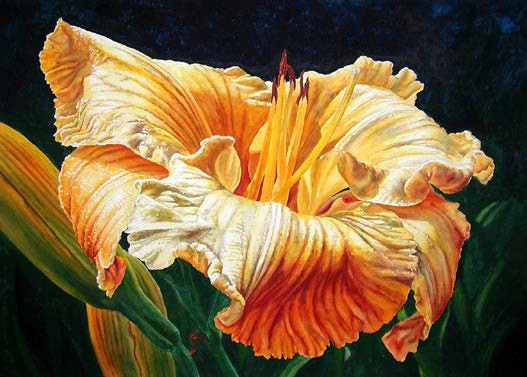
His architectural training, it turned out, was the perfect preparation. “The architectural drawings I did were very precise,” he says, “so the only way I can paint is very precise.” The fundamentals of drawing, proportion, perspective, and spatial thinking transferred directly — and what his training didn’t cover, his eye filled in. When he encountered silver and crystal objects that he wanted to paint and couldn’t find instruction on how to render them in watercolor, he simply figured it out himself. “I know this sounds really weird, but it didn’t take any time. I could just envision it.”
FINDING HIS SUBJECT
Inspired by the Dutch still life painters he had encountered during a posting in Germany with the U.S. Army, McCracken set out to answer a question that had nagged at him for years: was that level of realism possible in watercolor? The answer, as his paintings have demonstrated ever since, is an emphatic yes.
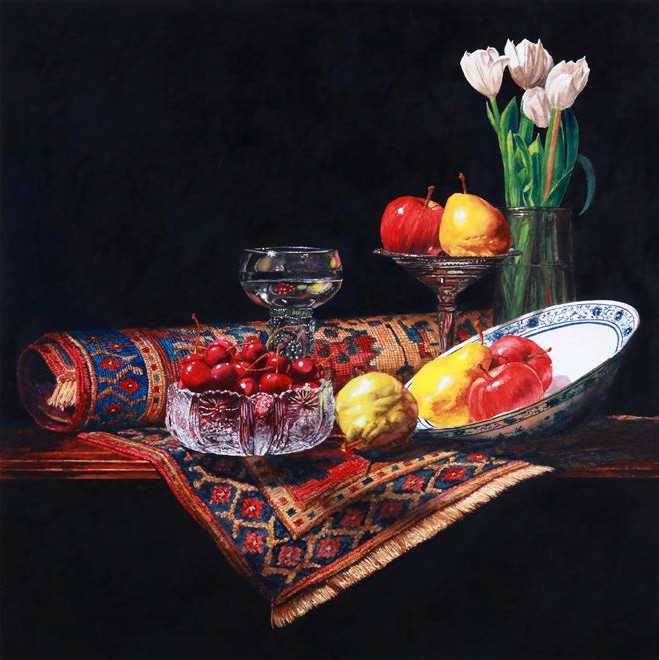
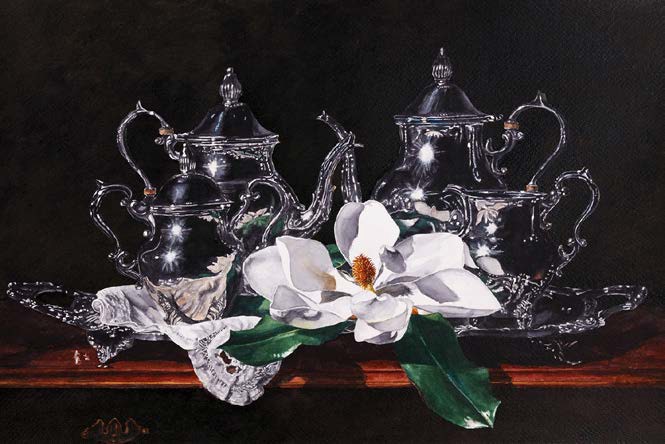
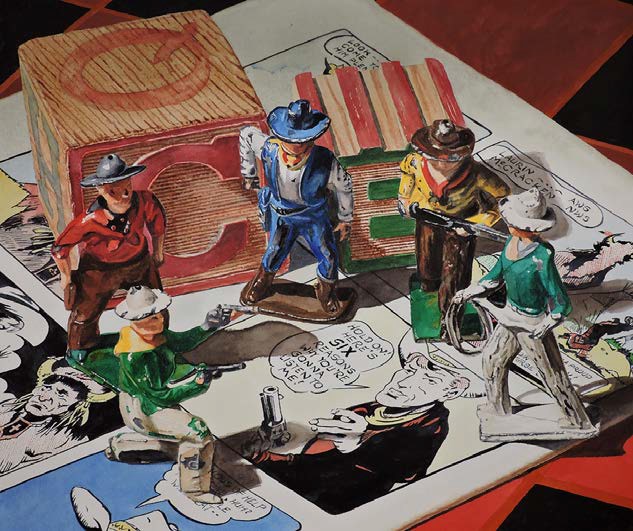
His still life arrangements — featuring silver services, cut crystal, Chinese porcelain, flowers, fruit, and, in more recent years, objects wrapped in aluminum foil and plastic bags — are among the most technically demanding works in contemporary watercolor. Each painting can take more than a hundred hours to complete. He typically works on three or four simultaneously, painting left to right, always tackling the most difficult element first.
“I love the whole thing,” he says of the process. “There’s no one part. It’s such a progression from the time I’m considering an object to the point where the painting is finished.”
MCCRACKEN BLACK AND THE VELVET BACKGROUND
Among McCracken’s most recognized contributions to watercolor technique is his signature deep, velvety black background — a surface so rich and luminous that it seems to glow from within. The secret, he explains, begins with an underpainting.
Early in his practice, McCracken noticed that even the finest watercolor papers contain tiny imperfections — spots where the sizing didn’t fully dissolve, leaving pinholes that show as white specks against a dark background. His solution was to apply a quick wash of whatever color he had in excess on his palette before laying in the black. The accidental discovery that followed changed everything.
“The blacks I painted over those pinhole-finding layers were sort of translucent,” he says. “When I held the painting up, I could not necessarily see, but I could feel the underpainting through the black.” He began experimenting deliberately — using phthalo blue beneath silver objects to make them look more metallic, or an Australian red beneath flowers to make them glow. “You can walk into a show of my paintings and never see that, but you can feel it, and when I point it out to you, you say, ‘Aha!’”
That pursuit of the perfect black eventually led to a collaboration with Daniel Smith, resulting in a proprietary color — McCracken Black — that has since become one of the company’s best-selling colors internationally. It is, he says, a black with no purple bias, built for layering, designed for silver. “My view is that an Escoda brush has a soul,” he says of his other signature tool. McCracken Black, one suspects, has one too.
THE DANCE
Ask McCracken about his philosophy of painting and he reaches for a metaphor that feels exactly right: “Watercolor is a dance that involves the artist, the paint, the brush, and the paper. The artist must lead in this dance and hope that the very active elements of this medium will participate and enhance the effort. I enjoy the dance.”
It is a dance he has been leading, with characteristic confidence and generosity, for more than three decades — teaching workshops, jurying competitions, organizing events, and making himself available to the watercolor community in ways that have earned him something rarer than technical admiration: genuine affection.
“I try to go to all the demos and all the meetings of my local watercolor society, just to be there to support them,” he says. “Over the course of my entire life, I’ve been very lucky to have mentors who were so gracious to me. I feel this absolute need to pass that on.”
As for the Lifetime Achievement Award — and the question of whether such a designation implies that the work is done — McCracken is characteristically untroubled. “I am so flattered to be recognized,” he says. Then, with the timing of a born storyteller: “Some days it’s just so much fun to be me.”
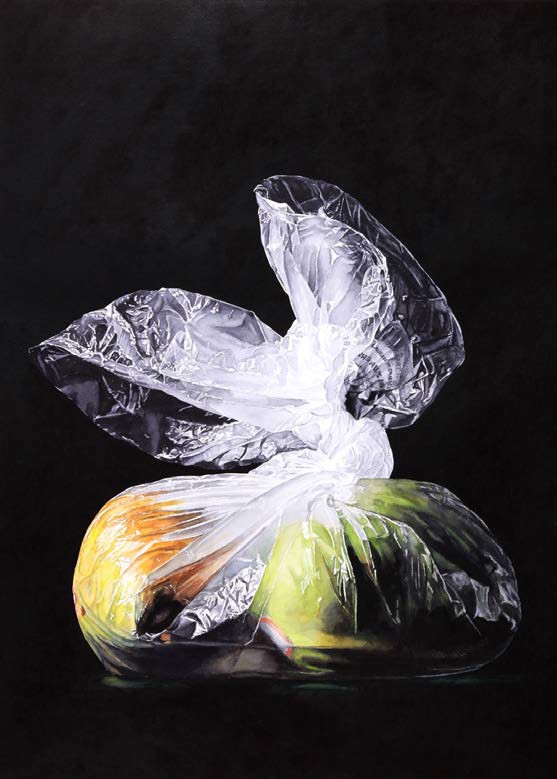
McCracken’s gift for making the most demanding subjects in watercolor look inevitable — the velvety black backgrounds, the luminous silver, the light refracting through cut crystal — didn’t happen by accident. It happened through decades of disciplined observation and technical experimentation.
In Watercolor Realism: Wood and Glass and Watercolor Realism: Silver and Crystal, he shares that hard-won knowledge about some of the most technically demanding still life watercolors being painted today.
The full interview, conducted by Kelly Eddington, appears in the Watercolor USA Honor Society Spring 2026 newsletter.