
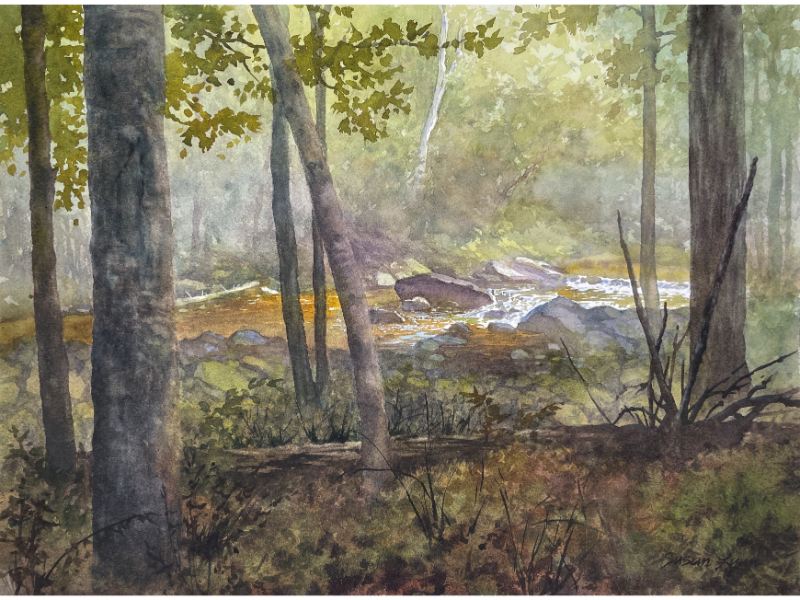
Step into a forest and the world rearranges itself. Light fractures into shards and ribbons. Greens multiply into infinite variations. Edges soften in the humidity of shade, while vertical trunks establish rhythm and structure. It has always been this way — for the painter, the forest is both gift and gauntlet.
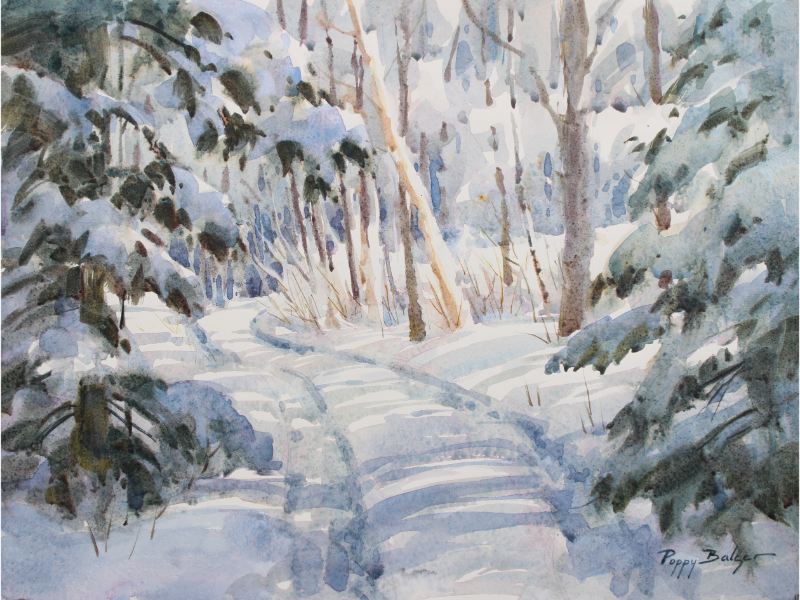
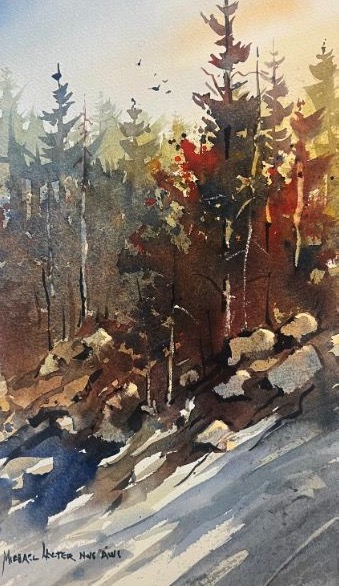
The three contemporary artists featured here know this challenge intimately. Translating the tangle of boles and branches into paint, they find order, poetry, and meaning. But they are hardly the first to be drawn into the woods. The history of American watercolor is, in no small part, a history of painters trying to render what light does to trees — and vice versa.
A Nation in the Forest
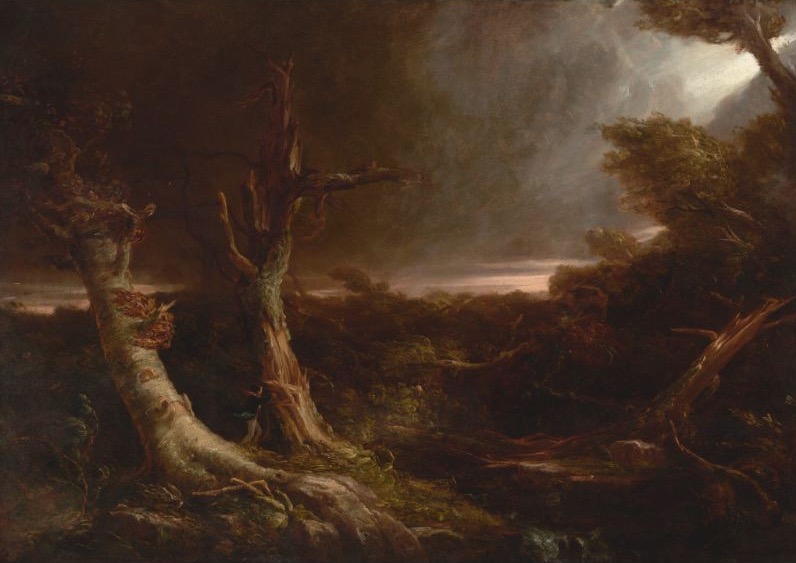
By the time watercolor emerged as a serious fine art in the latter half of the 19th century, the forest was already freighted with meaning. Thomas Cole, founder of the Hudson River School, understood the woods as both spiritual terrain and endangered sanctuary. His deep forest interiors, with trunks bending aside to reveal hidden pools and rocky clearings, visualized a landscape he feared was disappearing — cleared by ax and settlement even as he painted it. For Cole and his contemporaries, to paint the forest was to make an argument for its preservation.
Winslow Homer and the Working Forest
But perhaps no American watercolor painter pressed deeper into the woods than Winslow Homer. Beginning in the 1870s, he made repeated trips to the Adirondacks, combining his love of fishing and hunting with an unflinching eye for the forest as a working, breathing ecosystem rather than a picturesque backdrop.
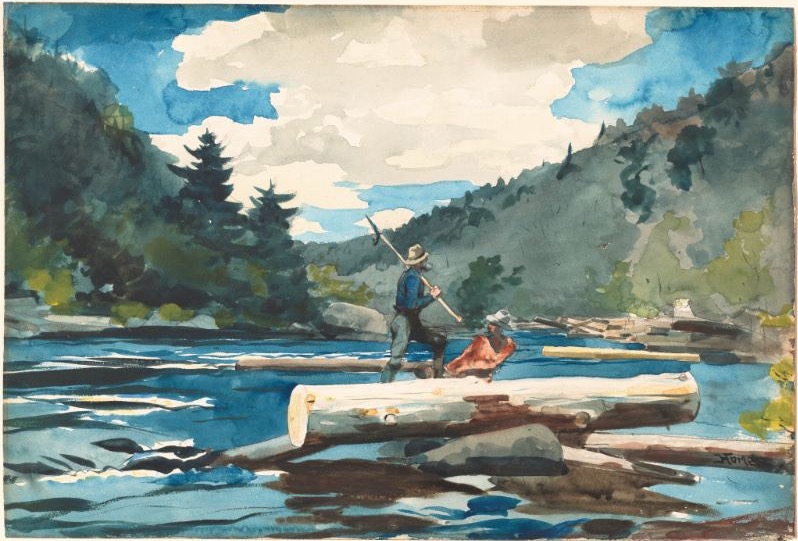
His 1891–92 watercolor Hudson River, Logging captures this with characteristic directness. The painting documents something Homer had witnessed firsthand: felled trees rolling into the rushing Hudson, log drivers guiding them downstream to distant sawmills. The forest here is not sublime scenery but economic resource, and Homer renders it with all the ambiguity that implies. Adirondack Park was established around this same time to protect the very landscape his brush recorded. He was painting an elegy without quite calling it one.
What makes Homer’s forest watercolors so instructive for contemporary painters is his economy. He understood that the forest interior could overwhelm, and he composed ruthlessly — selecting one or two dominant trunks, massing the shadows, letting the white of the paper carry the light filtering through the canopy above.
Sargent in the Undergrowth
He was not alone in finding the woods a place of creative freedom. A generation later, John Singer Sargent — better known for his Gilded Age portraits — discovered the same thing, though he arrived there by a different road. After 1910, when he largely abandoned portraiture, watercolor became the primary medium through which he explored the natural world on his own terms.
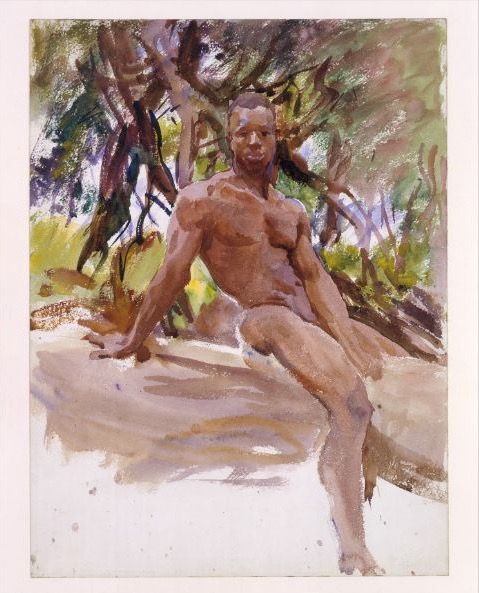
His forest and woodland watercolors — painted in the Rocky Mountains, the Italian lake district, and the woods of Florida — show a painter reveling in exactly the problems that make trees difficult: overlapping branches, filtered light, the near-abstract texture of bark. Sargent brought to these scenes the same bravura technique he had developed in portraiture, working fast and confidently, using broad brushstrokes to delineate trunks and leaving the paper bare where light struck. He scratched into the paper surface, applied wax resist, pooled and scraped — building a vocabulary of marks that seems almost recklessly free and yet describes the woods with uncanny accuracy. For Sargent, the forest was where watercolor could finally do what oil paint could not.
The Continuing Conversation
What unites past and present is the medium itself. Watercolor remains uniquely suited to the forest because the forest is itself a study in transparency and layering — light through leaves, mist between trunks, shadow upon shadow. The paintings gathered here remind us why artists keep walking into the woods, paper and brush in hand, searching for what lives at the edge of legibility.
And if this story has you longing to put brush to paper in the woods yourself, here’s your invitation: this June, join Eric Rhoads and a tight-knit group of fellow painters for eight days of plein air painting in the Adirondack Mountains, June 6–13, 2026. No workshops. No competition. Just painters, good food, and some of the most beautiful forest landscape in America.