
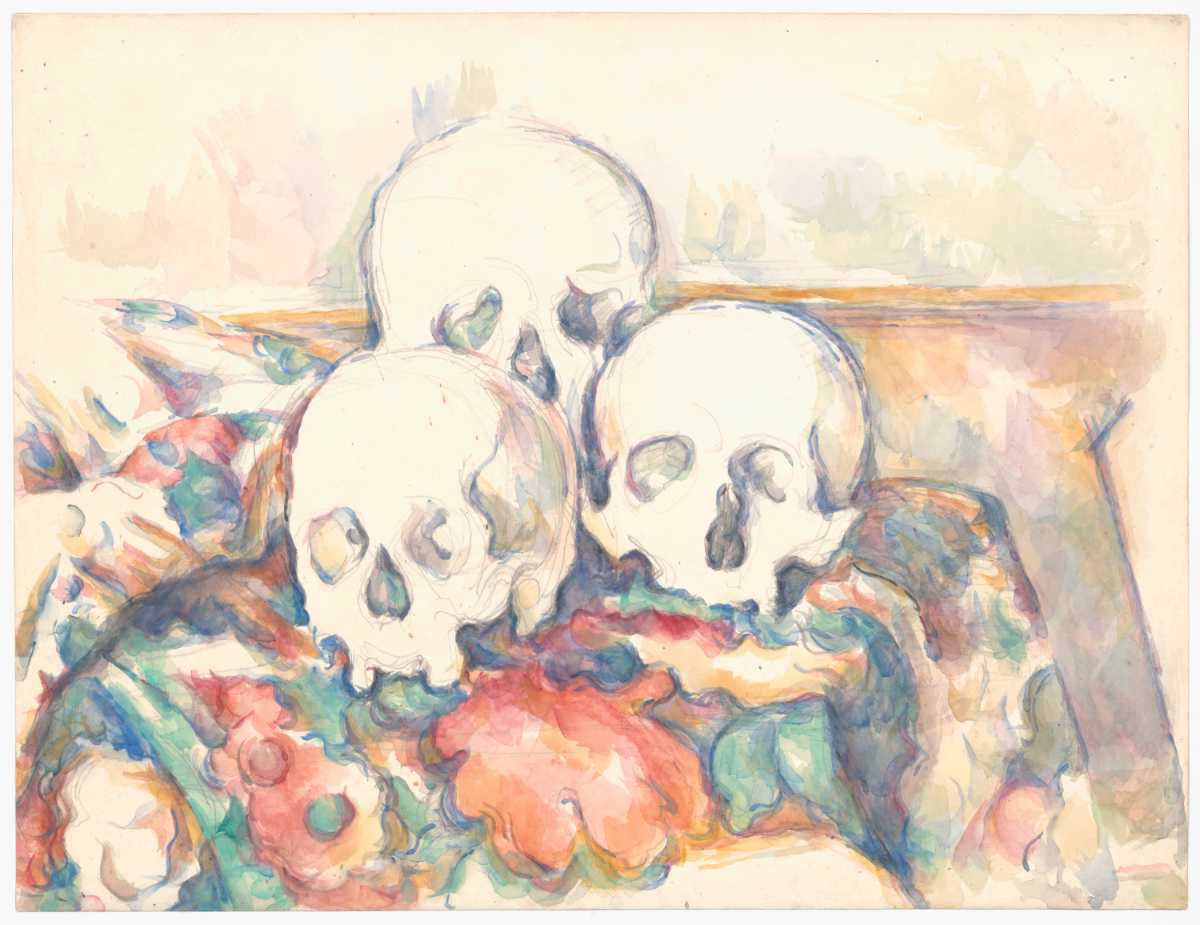
“I proceed very slowly,” Paul Cézanne once wrote. “Nature presents itself to me with great complexity.”
If you’ve ever stood in front of a subject and felt overwhelmed by everything you were seeing, you understand exactly what he meant.
That complexity — and Cézanne’s patient response to it — comes into focus in The Three Skulls (1902–06), a watercolor that reveals how he built form, space, and atmosphere step by deliberate step, layer by layer.
Cézanne wasn’t chasing a perfectly polished surface. He pursued something he called réalisation — a kind of visual “rightness” achieved through adjustment and reassessment rather than execution of a fixed plan. He allowed the painting to evolve. And crucially, he didn’t hide that evolution. He didn’t scrape away or erase. He added. He layered. The finished work doesn’t conceal its making — it reveals it.
In The Three Skulls, he begins with a loose graphite drawing to establish the skulls, patterned cloth, table edge, and chair rail. But he doesn’t bury the drawing under washes. The pencil remains visible, sometimes reinforcing the forms and sometimes operating independently from the color. Line and wash don’t always align perfectly — and that tension is part of what makes the painting feel alive. As viewers, we find ourselves shifting between structure and sensation.
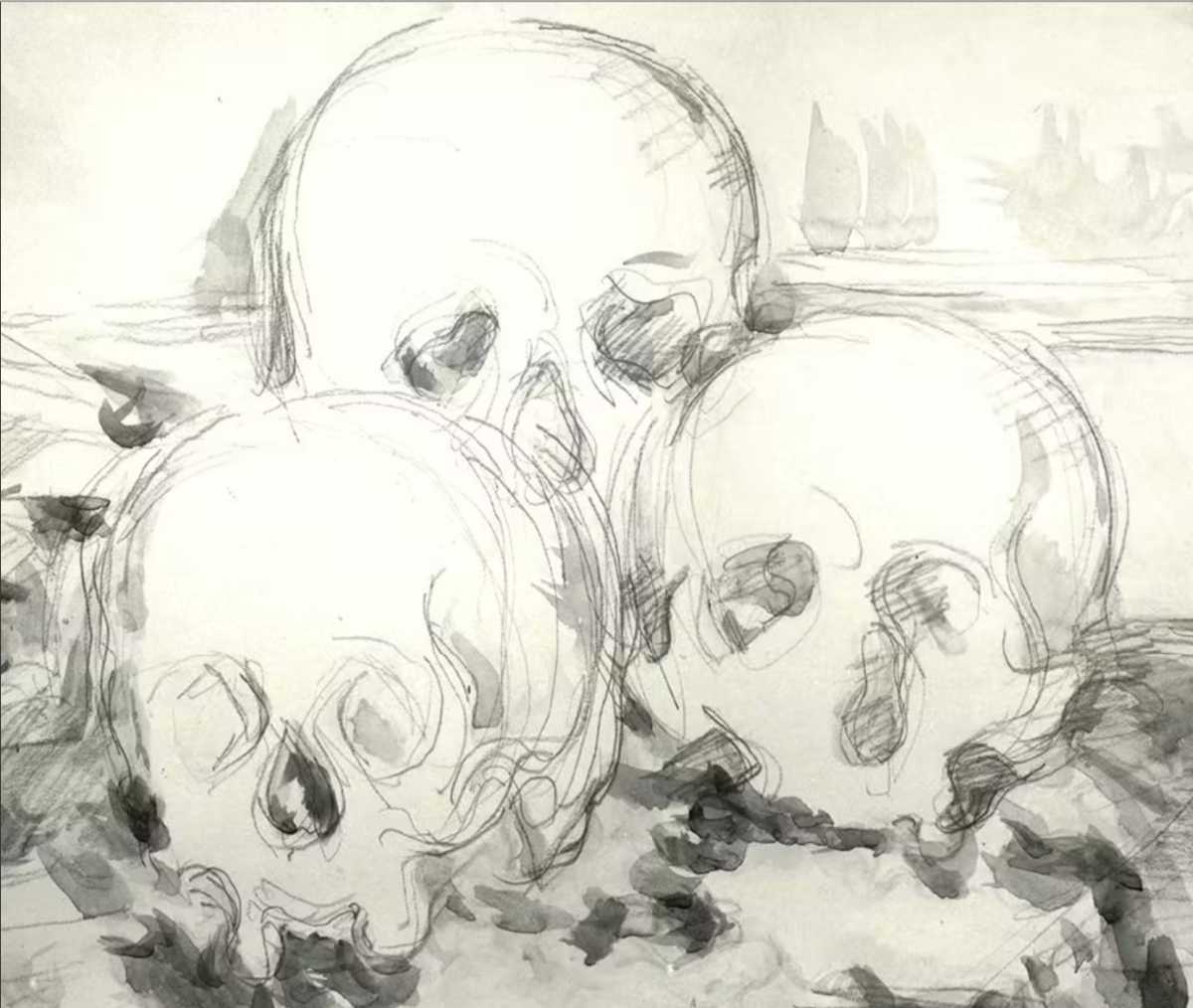
CÉZANNE’S PROCESS
Cézanne didn’t rely on lifting or blotting to recover highlights. He preserved the white of the paper from the start. The ivory sheet becomes an active participant in the image, reflecting light through transparent washes and standing in for the luminous planes of bone. The skulls feel rounded not because of heavy shading, but because of a delicate balance between pale washes, exposed paper, and spare graphite contours.
In the darker recesses — the eye sockets and the spaces between skulls — he deepens tone with layered blues, especially indigo. But the shadows remain transparent and breathable. Cézanne said that to make viewers “feel the air,” artists must introduce sufficient blues into reds and yellows. In this watercolor, blue is more than shadow — it’s atmosphere. It vibrates between objects, animates negative space, and subtly destabilizes edges so that nothing feels rigid or fixed.
His process was incremental. He allowed washes to dry before adding more, understanding watercolor’s transparency and its limits. In the patterned textile beneath the skulls, he layered transparent reds with more opaque passages, varied the intensity of greens, and punctuated areas with matte cobalt blue. The pattern doesn’t simply describe fabric; it activates the surface. Some strokes sit boldly on top, while thinner washes recede, creating a push and pull across the paper.
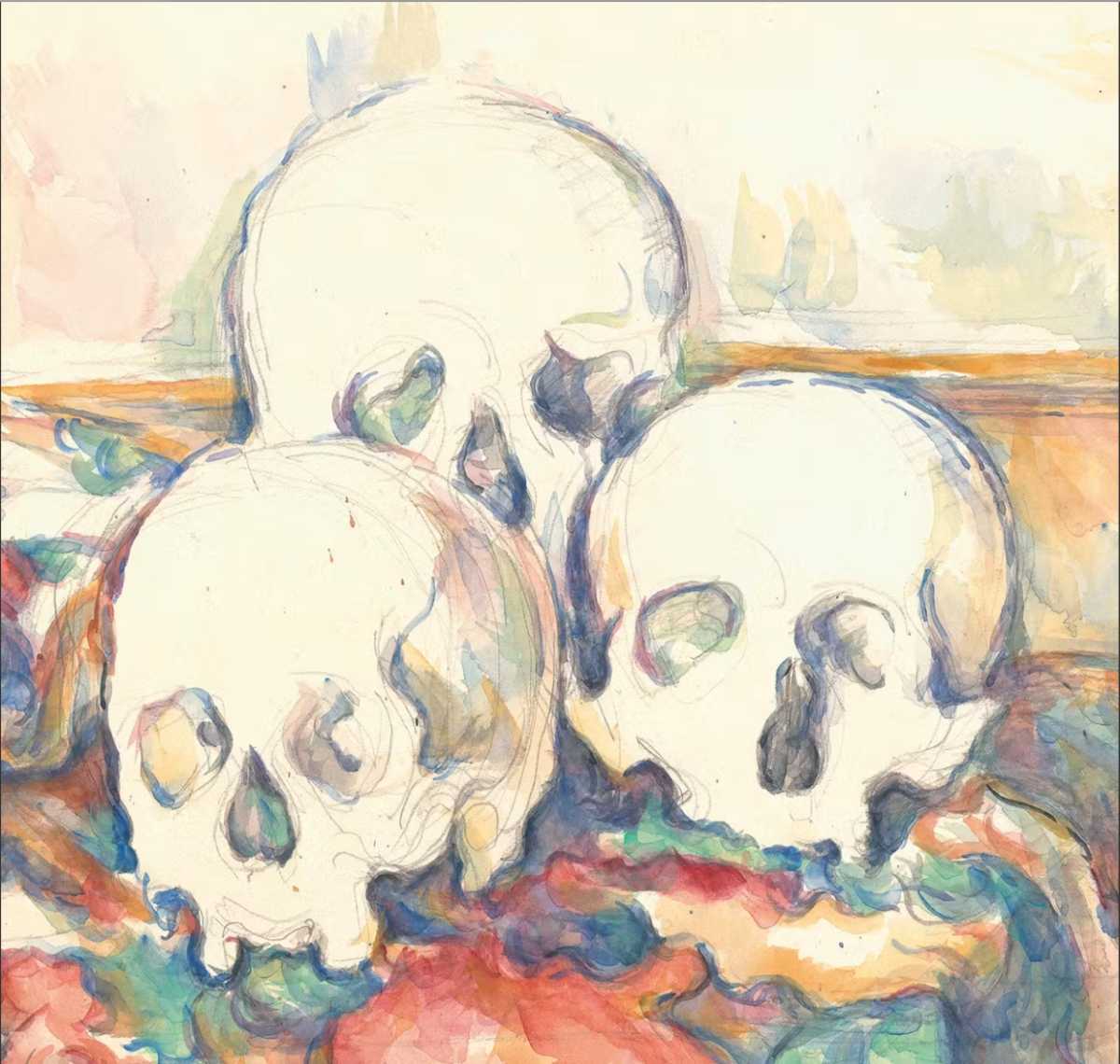
He also leaves passages unresolved. Parts of the background wall remain bare. The textile’s edge is only partially developed. These open areas introduce ambiguity. The skulls feel both anchored and suspended, reminding us that we’re looking at a constructed surface, not a fixed illusion.
WERE CÉZANNE’S WATERCOLORS STUDIES — OR FINISHED WORKS?
For years, scholars debated whether Cézanne’s watercolors were simply studies for his oils. But closer study suggests something more nuanced — and more interesting.
Many of his late still-life watercolors are large and highly resolved—finished in their own right.
When he explored a subject in both oil and watercolor — as he did with The Three Skulls and the related oil Three Skulls on a Patterned Carpet (1904) — he wasn’t repeating himself. He was testing perception through different materials. Each medium allowed him to discover something new about light, structure, and atmosphere.
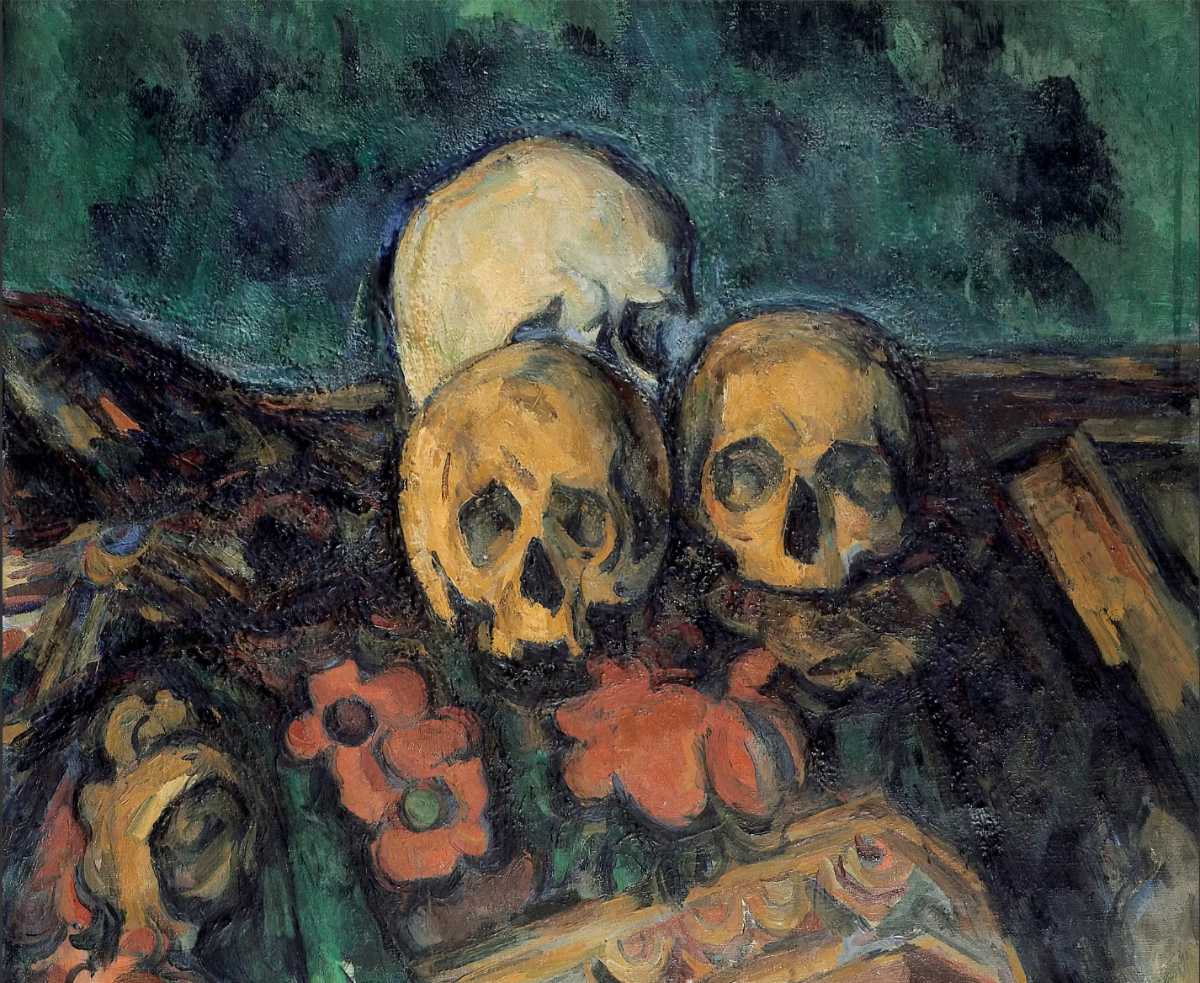
The oil is dense and fully covered, its tones rich and weighty. The watercolor, by contrast, feels lighter and more ephemeral, its exposed paper carrying much of the illumination. Oil explores solidity. Watercolor explores sensation.
Each medium asked different questions. And Cézanne answered both.
PARALLEL TO NATURE
Ultimately, The Three Skulls isn’t just a meditation on mortality. It’s a study in perception. Cézanne wasn’t copying objects; he was translating his experience of seeing them into a structure of line and color. Through visible drawing, layered washes, exposed paper, and vibrating blues, he achieved what he called “a harmony parallel to nature” — not an imitation of reality, but its painted equivalent.
In doing so, he reshaped the language of painting. His watercolors show that resolution doesn’t mean erasing the process. It means allowing structure, sensation, and material to exist together in luminous balance.
Follow in Cézanne’s Footsteps: The Secret Masters Know
Artists create boundaries and hit an invisible wall when they stick to just one medium.
- Watercolorists can feel timid about the medium’s unforgiving nature, producing paintings that look pale or washed-out.
- Oil painters can become rigid and formulaic, missing the freshness and sparkle that could elevate their work.
In “Seascapes in Oil & Watercolor,” Brienne Brown shows you how working across mediums doesn’t just double your skills — it multiplies them!