

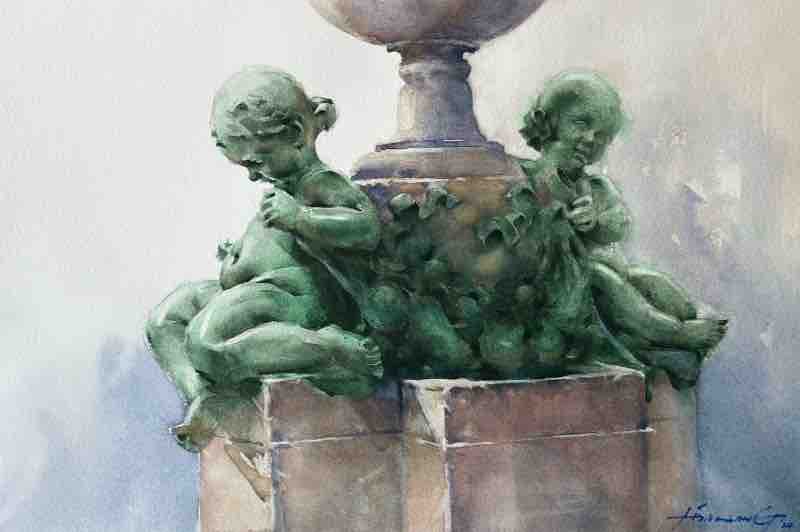
With only a one-day stop in Barcelona, the artist didn’t have time to make a plein air study at the Font dels Sis Putti. She studied two of the bronze babies seated at the foot of an urn and snapped some photo references to refresh her memory back in the studio. “Green colors are hard to handle,” she says, “they get muddy easily. The challenge for this painting was to keep the colors clean and express the texture without over-rendering.”
Rather than start with thumbnail sketches, Lisa Wang visualizes the whole painting in her mind. “I painted so many thumbnails as a student, I don’t need to anymore,” she says. “Now I paint in my head before I even pick up a pencil.”
With an image in place of what she hopes to achieve, she then draws the subject on her painting surface, typically 300-lb. rough paper. “From my time as a fashion designer, I easily can fall back into the tight, neat style of illustration work. I need a paper that encourages me to paint loose and allows for a variety of brushstrokes. I can’t get that with a smooth surface.”
For this step, she also opts for a 0.72B mechanical pencil, which she finds ideal for making crisp lines. “On location, I don’t need a lot of shading or messy edges, which just makes things difficult when I start to add color.” Then, just before she begins painting, she goes back into the drawing with a kneaded eraser to gently break the rigidity of the line in places, encouraging a combination of soft and hard edges in the work.
Even then, however, she doesn’t consider the drawing finished until the painting is finished. “When I’m painting, I don’t want to be confined by the edges of the drawing. I continue to draw with my brush throughout the process. If you make a perfect drawing and then just color it in, like paint by number, your painting can never be live; it can never have a sense of spirit.”
REARRANGING REALITY FOR BETTER COMPOSITIONS
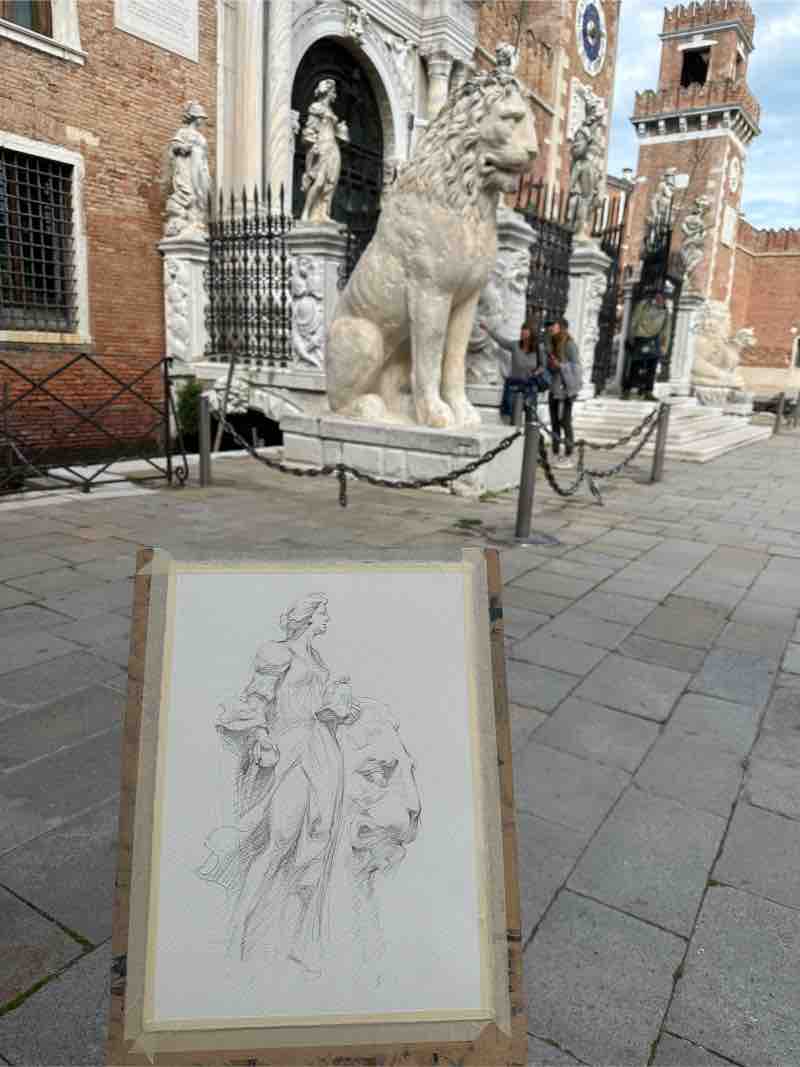
As part of her exploration of a subject, the artist is not afraid to reimagine a composition. In the case of a group of old statues she encountered at the entrance of the Venetian Arsenal, she says: “Even though the lion is dominant, I liked the female statue because I could see her much better framed by the dark door. But the sculpted figure by herself wasn’t balanced, so I added the lion behind her. When we’re on location, we don’t need to copy exactly what we see. We can edit out things we don’t want, borrow things from another location, or even rearrange the composition altogether.”
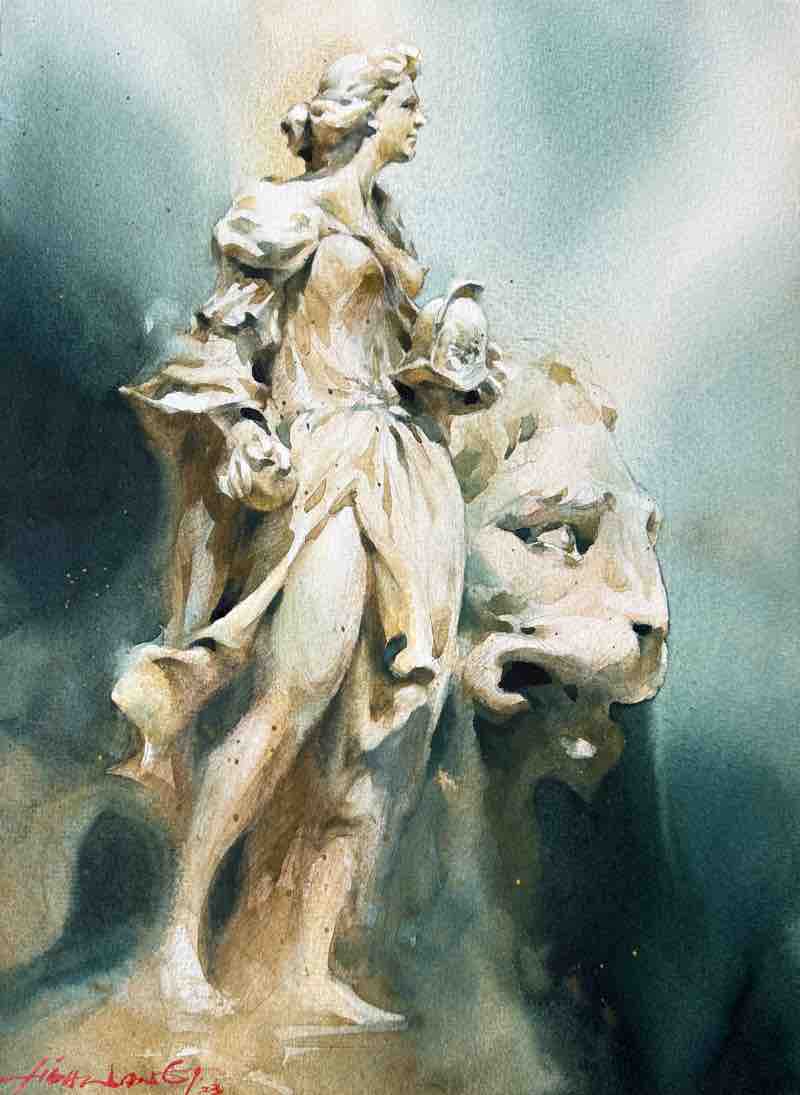
Because the female figure holds an apple in her right hand, the artist initially thought she represented Eve—but the statue actually depicts Venus, the Roman goddess of love. The golden apple signifies the one awarded to her by Paris for being the fairest of the goddesses.
Join Geoffrey Allen, Brienne Brown, Kathleen Giles, Antonio Masi, and other top watercolor artists from around the world at Watercolor Live in January!